
The XW630F is the engine that powers itself: electronic fuel injection holds the mixture across altitude and temperature, and the integrated starter-generator cranks the engine and feeds the aircraft’s 28 V bus — no separate alternator to buy or mount.
Highlights
No re-jetting, cleaner starts, ≤450.1 g/kW·h specific fuel consumption (manufacturer specification)†.
Dynamometer data published: peak starter bus current 235 A, controllable idle at 1,800 rpm†.
300 MHz MCU with ETPU co-processing; vector-controlled smooth-start reduces prop strike shock†.
Applications
50–150 kg MTOW VTOL and fixed-wing airframes (CQ55A–CQ90A class) · Hybrid powertrain conversions · ISR and mapping platforms
Product Images
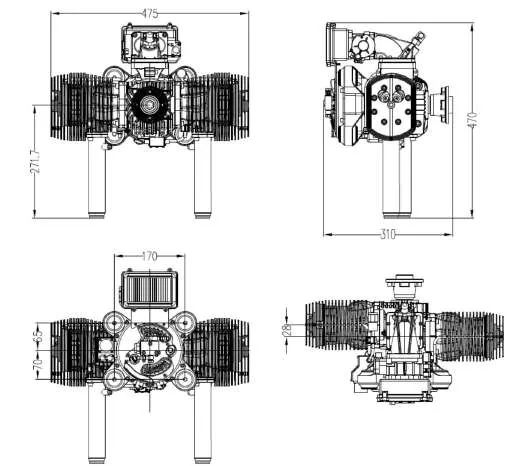
Full Specifications
| Item | Value | Evidence |
|---|---|---|
| Layout | Twin boxer, 2-stroke EFI | Manufacturer spec |
| Displacement | 630 cc | Manufacturer spec |
| Max power @6,500 rpm | 31.5 kW | Bench test (T1) |
| Weight | 18.6 kg incl. starter-generator | Manufacturer spec |
| Starter bus peak current | 235 A | Bench test (T1) |
| Controllable idle | 1,800 rpm | Bench test (T1) |
| Rectifier output | 28 V DC, 100 A max, 96% eff. | Manufacturer spec |
| Specific fuel consumption | ≤450.1 g/kW·h | Manufacturer spec |
| Fuel | 93 RON gasoline | Manufacturer spec |
| Mounting interface | 170×135 mm, 4×φ8 bosses | Manufacturer spec |
FAQ
Can the engine power avionics directly?
Yes — the integrated starter-generator delivers 28 V DC up to 2.8 kW through a 100 A rectifier (manufacturer specification).
Is bench data available?
Yes — dynamometer report (max power, starter bus current, idle control) is shared under NDA for qualified RFQs.