
The Benelabo engine catalog now spans two propulsion families built for UAV airframe designers: the XW piston family — six gasoline engines from an 8.68 kW light twin to 37 kW flagships — and a turbojet family in 19 / 60 / 80 / 160 kg thrust classes. Every engine ships with integration documentation; the XW630F flagship is bench-tested with published data.
Evidence levels: XW630F power figure bench-tested (T1); other figures manufacturer specification (T2). Piston family details: XW630F · XW996F · XW120F · XW170F · XW350F · 4TK66FD. Turbojets: SW190B · SW600Pro · XW800Pro · SW1600Pro
Piston Engines — the XW Family
3.05 kg light twin, CDI, 50:1 mix — the entry point of the piston line.
170 cc twin with three-bearing crank, 300×230×230 mm footprint.
350 cc workhorse; optional 36 V alternator and 24 V electric start.
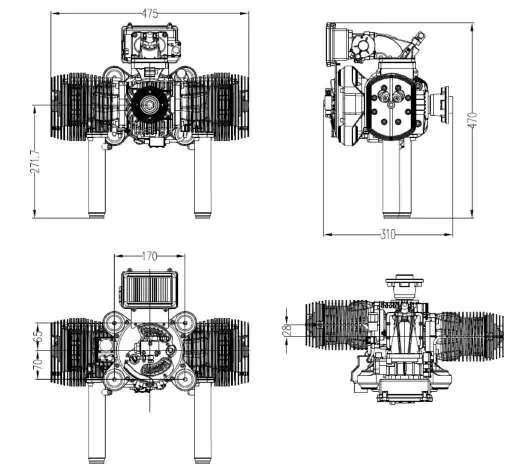
630 cc EFI flagship, bench-tested; 28 V / 2.8 kW integrated starter-generator.
550 cc four at 21.6 kg all-in — 1.71 kW/kg installed, RS232 telemetry.
996 cc four-stroke EFI flagship, 30 kg — the heavy-airframe pick.
Turbojet Engines
1.5 kg micro-jet, 38,000–120,000 rpm, 3S LiPo start.
12,000 m ceiling, 20 G catapult rating, 300 m/s; kerosene or diesel.
φ207×455 mm, 9.5 kg core, one-touch start, 25 h interval.
12,000 m ceiling, 10 G launch rating, integrated 800 W generator.
Selection by Airframe Class
- ≤25 kg MTOW (light fixed-wing, target platforms): XW120F / XW170F
- 50–150 kg MTOW (CQ55A–CQ90A class VTOL and fixed-wing): XW350F / XW630F
- ≥150 kg MTOW (CQ150A/CQ180A, heavy fixed-wing): 4TK66FD / XW996F
- Jet targets & high-speed drones: SW190B / SW600Pro / XW800Pro / SW1600Pro
Applications
Fixed-wing ISR & mapping airframes | VTOL hybrid powertrains | Jet targets & high-speed drones | R&D integration programs
Product Images
The XW Piston Family — Power Ladder
| Model | Layout | Displacement | Max Power | Weight | Signature |
|---|---|---|---|---|---|
| XW120F | Twin boxer, 2-stroke | — | 8.68 kW (11.6 hp) | 3.05 kg† | push-pull install |
| XW170F | Twin boxer, 2-stroke | 170 cc | 13.97 kW | 3.97 kg† | three-bearing crank |
| XW350F | Twin boxer, 2-stroke | 350 cc | 21.6 kW | 10.9 kg† | opt. 36 V alternator |
| XW630F | Twin boxer, 2-stroke EFI | 630 cc | 31.5 kW @6,500 rpm (bench) | 18.6 kg† | 28 V / 2.8 kW integrated |
| 4TK66FD | Four boxer, 2-stroke EFI | 550 cc | 37 kW @7,500 rpm | 21.6 kg all-in† | 1.71 kW/kg + RS232 |
| XW996F | Four boxer, 4-stroke EFI | 996 cc | 37 kW @7,500 rpm | 30 kg† | flagship |
Turbojet Family — Thrust Ladder
| Model | Thrust | Dimensions | Weight | Notables |
|---|---|---|---|---|
| SW190B | 19 kg | φ109.5×260 mm | 1.5 kg† | 3S LiPo start |
| SW600Pro | 60 kg | φ177×452 mm | 6.8 kg† | 12,000 m / 20 G / 300 m/s |
| XW800Pro | 80 kg | φ207×455 mm | 9.5 kg† | one-touch start |
| SW1600Pro | 160 kg | φ258×536.9 mm | 17 kg† | 12,000 m / 800 W generator |
FAQ
Do the piston engines support heavy fuel (JP-8)?
The current piston family runs gasoline (93/95 RON); heavy-fuel variants are on the engineering roadmap — ask for the roadmap in your RFQ.
What fuel do the turbojets use?
Aviation kerosene (the SW600Pro also runs diesel) with 3–5% turbine oil, on a 25-hour service interval.
What makes EFI worth it on a UAV?
Automatic mixture compensation across altitude and temperature, easier cold starts and lower fuel burn versus carbureted equivalents (manufacturer specification ≤450.1 g/kW·h for XW630F).
Can the engines power avionics directly?
Yes — XW630F integrates a 28 V / 2.8 kW starter-generator; the 4TK66FD carries a 28 V generator up to 1600 W; the SW1600Pro outputs 800 W.