
The XW630F is the engine that powers itself: electronic fuel injection holds the mixture across altitude and temperature, and the integrated starter-generator cranks the engine and feeds the aircraft’s 28 V bus — no separate alternator to buy or mount.
Product Images
Highlights
No re-jetting, cleaner starts, ≤450.1 g/kW·h specific fuel consumption (manufacturer specification)†.
Dynamometer data published: peak starter bus current 235 A, controllable idle at 1,800 rpm†.
300 MHz MCU with ETPU co-processing; vector-controlled smooth-start reduces prop strike shock†.
Applications
50–150 kg MTOW VTOL and fixed-wing airframes (CQ55A–CQ90A class) · Hybrid powertrain conversions · ISR and mapping platforms
Piston Engine Family — 8.7 to 37 kW
| Model | Layout | Size | Max power | Weight | Onboard power |
|---|---|---|---|---|---|
| XW120F | Twin boxer, 2-stroke | 45×35 mm bore×stroke | 8.68 kW | 3.05 kg | — |
| XW170F | Twin boxer, 2-stroke | 170 cc | 13.97 kW | 3.97 kg | — |
| XW350F | Twin boxer, 2-stroke | 350 cc | 21.6 kW | 10.9 kg | Opt. 36 V 500–1000 W |
| XW630F | Twin boxer, 2-stroke EFI | 630 cc | 31.5 kW (bench-tested) | 18.6 kg | 28 V / 2.8 kW starter-generator |
| 4TK66FD | Four-cylinder boxer, 2-stroke | 550 cc | 37 kW | 21.6 kg | 28–29 V @3,500 rpm, up to 1600 W |
| XW996F | Four-cylinder boxer, 4-stroke EFI | 996 cc | 37 kW | 30 kg | — |
Highlighted row = this model. All figures are manufacturer specifications; full tables live on each model page (linked). Family hub: /uav-engines/
How to Choose in This Family
- Power class. The line steps 8.68 → 13.97 → 21.6 → 31.5 → 37 kW; pick the smallest unit that covers cruise plus climb margin — excess kilograms cost endurance twice.
- Integrated electricity. Airframes that need 28 V onboard power take the XW630F starter-generator or 4TK66FD coaxial generator instead of bolt-on alternators.
- Stroke and fuel logistics. Two-stroke members run 92–95 RON with mix oil; the four-stroke XW996F trades weight for plain-gasoline simplicity.
Where this model sits: XW630F is 28 V / 2.8 kW starter-generator.
Full Specifications
| Item | Value | Evidence |
|---|---|---|
| Layout | Twin boxer, 2-stroke EFI | Manufacturer spec |
| Displacement | 630 cc | Manufacturer spec |
| Max power @6,500 rpm | 31.5 kW | Bench test (T1) |
| Weight | 18.6 kg incl. starter-generator | Manufacturer spec |
| Starter bus peak current | 235 A | Bench test (T1) |
| Controllable idle | 1,800 rpm | Bench test (T1) |
| Rectifier output | 28 V DC, 100 A max, 96% eff. | Manufacturer spec |
| Specific fuel consumption | ≤450.1 g/kW·h | Manufacturer spec |
| Fuel | 93 RON gasoline | Manufacturer spec |
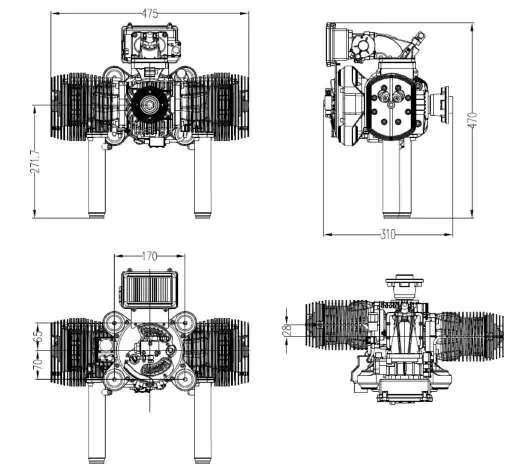
| Mounting interface | 170×135 mm, 4×φ8 bosses | Manufacturer spec |
Ordering & Delivery — What to Know Before You Buy
MOQ, lead time, payment terms, customization scope and export-licensing documentation are confirmed per quotation — send your mission profile, target quantity and destination port with the RFQ. Standard flow below:
RFQ → engineering proposal with mission math → production and factory testing → licensed export via major Chinese ports with end-user documentation. Training and spare-parts programs available.
Compliance & Licensed Export
Not subject to US ITAR — this product is exported from China under applicable regulations with valid export licenses, the same compliance posture across every Benelabo product line.
- Licensed export with end-user documentation on every shipment
- Buyers screened as part of every quotation; an export compliance statement accompanies each quotation
- Government and agency products are supplied only to authorized organizations
- Every published figure on this page is labeled manufacturer-spec or bench-tested
FAQ
Can the engine power avionics directly?
Yes — the integrated starter-generator delivers 28 V DC up to 2.8 kW through a 100 A rectifier (manufacturer specification).
Is bench data available?
Yes — dynamometer report (max power, starter bus current, idle control) is shared under NDA for qualified RFQs.