Last updated: September 2026
Guide
Nine range steps, one decision framework: match spool length to mission radius, weight to your payload margin, and connectors to your ground system.
What a fiber spool does
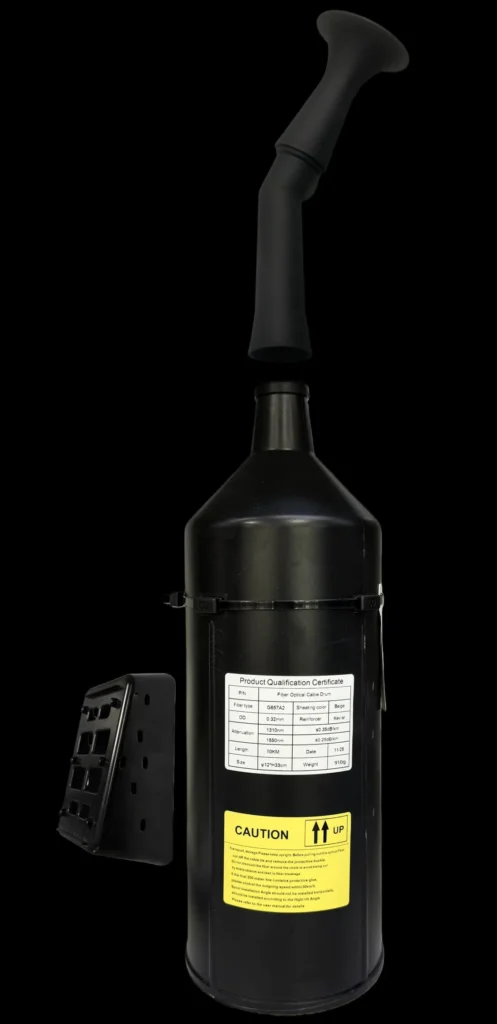
A spool pays out hair-thin optical fiber as the drone flies, keeping control and video on a physical link that cannot be radio-jammed — with near-zero latency.
Step 1 — Length
Mission radius plus margin: 3–50 km in nine steps (3/5/10/15/20/25/30/40/50 km). Longer is not automatically better — weight grows with length.
Step 2 — Weight
80 g/km fiber plus the ABS reel: 369 g at 3 km, 910 g at 10 km, 3.7 kg at 50 km (manufacturer specification)†. Check the total against your payload budget.
Step 3 — Connector & loss
FC/UPC standard. Pre-computed link loss: ≤2.1 dB (3 km) to ≤16 dB (50 km) including connectors†; attenuation ≤0.25 dB/km @1550 nm, ≤0.35 dB/km @1310 nm.
Integration
Supplied as spools alone or as a configured package with beneuav platforms — payoff mechanics and opto-electric interface included.
FAQ
How much does a 50 km spool weigh?
3.7 kg including the ABS reel (manufacturer specification).
Which fiber is used?
G657A2 bend-insensitive single-mode, 0.27 mm class, −40 to +85 °C.