Gyros & INS
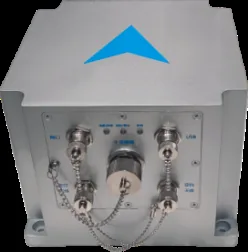
Fourteen strapdown INS/GNSS systems — nine land & air units from compact F940M to survey-grade F992, plus five pressure-rated subsea variants to 6000 m. Heading from ±0.05° (single-antenna) with odometer/DVL aiding across the family.
Series Overview — Land & Air Units
| Model | Gyro bias ≤ | Heading ≤ | Attitude ≤ (RMS) | Pure inertial ≤ | Weight ≤ | Dimensions (mm) | Power ≤ |
|---|---|---|---|---|---|---|---|
| F940M | 0.3°/h | 0.05° (single-ant. RMS) | 0.03° | 1 km / 10 min | 650 g | 80.5×80×73 | 8 W |
| F94X (F940/F941/F942) | 0.3–0.05°/h | 0.05° (single-ant. RMS) | 0.03° | 8–3 nm/h | 0.85 kg | 80.5×80×84 | 15 W |
| F950 | 0.3°/h | 0.05° (single-ant. RMS) | 0.02° | 5 nm/h | 2.6 kg | 145×121.5×125 | 20 W |
| F960 | 0.05°/h | 0.05° (single-ant. RMS) | 0.01° | 3 nm/h | 2.6 kg | 145×121.5×125 | 20 W |
| F970 | 0.05°/h | 0.05° | 0.01° | 1.5 nm/h | 3 kg | 160.8×133.6×117 | 25 W |
| F980 | 0.02°/h | 0.05° | 0.01° | 0.8 nm/h | 3 kg | 160.8×133.6×117 | 25 W |
| F990 | 0.01°/h | 0.03° | 0.005° | 0.5 nm/h | 6 kg | 190×152×140 | 25 W |
| F991 | 0.01°/h | 0.03° | 0.005° | 1 nm/h | 7 kg | 191×179×126.5 | 20 W |
| F992 | 0.01°/h | 0.03° | 0.003° | 0.5 nm/h | 7 kg | 179.6×179.6×145 | 20 W |
Pressure-Rated Subsea Variants
| Model | Pressure rating | Material | Weight ≤ | Dimensions | DVL aiding | Operating temp |
|---|---|---|---|---|---|---|
| F940SD | 350 m (Al) / 1000 m (Ti) | Aluminum / Titanium | 3 kg / 4 kg | φ143.2×203 mm | 1000 kHz, bottom track 0.2–45 m | −5…+65 °C |
| F941S | 500 m (Al) / 6000 m (Ti) | Aluminum / Titanium | 4 kg / 5.5 kg | 145×147×162 mm | DVL-aided, 1%×D | −40…+65 °C |
| F980S | 500 m (Al) / 6000 m (Ti) | Titanium | 25 kg | φ260×280 mm | DVL-aided, 0.2%×D | −40…+65 °C |
| F980SD | 3000 m (Ti) | Titanium | 38 kg | φ313×561 mm | 600 kHz, bottom track 0.5–200 m | −5…+65 °C |
| F990SD | 3000 m (Ti) | Titanium | 38 kg | φ260×397 mm | 150 kHz, bottom track 2–450 m | −5…+65 °C |
Gyro Grade Classification
Industry convention places the navigation-grade threshold at a gyro bias stability of 0.01°/h: the F990, F991 and F992 (0.01°/h, 1σ, 10 s) meet this threshold, the F980 family (0.02°/h) sits in the high-tactical band, and the F94X/F950 entry units (0.1–0.3°/h) serve cost-driven tactical applications. All F9 models use fiber-optic gyros, which hold their bias in vibration and temperature far better than MEMS at this class, without the size and cost of ring-laser gyros (manufacturer specifications).
Not subject to US ITAR — exported under applicable regulations with valid export licenses.
Common Capabilities
Integrated GNSS with odometer/DVL external aiding, heave accuracy 5 cm or 5%, data update ≤200 Hz, 10–36 V DC supply (18–36 V on pressure variants), RS-232/RS-422/CAN/Ethernet interfaces, GJB150 vibration and shock compliance (manufacturer specifications).
Applications
UAV navigation · vehicle and marine survey · antenna stabilization · mapping · precision agriculture · downhole and subsea (pressure variants).
Which F9 model for UAV use?
F94X/F950 cover most UAV navigation budgets; F990+ for survey-grade. Send accuracy and GNSS-denied requirements via RFQ.
GNSS-denied performance?
Every model supports pure inertial and odometer/DVL-aided modes — drift figures per model in the tables above.
FOG or MEMS for a UAV autopilot?
MEMS gyros win on size, cost and power, but their bias drifts with vibration and temperature; a fiber-optic gyro holds 0.01–0.3°/h bias in the same conditions, which is what keeps heading stable in GNSS-denied flight. For payloads that depend on accurate pointing or mapping-grade navigation, FOG-based INS are the standard choice.
Subsea or downhole?
The five SD/pressure-rated variants go from 350 m to 6000 m — aluminum for shallow, titanium for deep water; integrated DVL on F940SD/F980SD/F990SD.
Request a Quote Request Datasheet
Product Images